

Why Kids' Clothes Sizing Varies So Much: A Parent's Guide

Table of Contents
- Why Kids' Clothes Sizing Varies So Much
- Why Kids' Clothes Sizing Varies Between Brands
- How to Measure Children for Clothes Accurately at Home
- Reading a Children's Clothing Size Chart by Age and Height
- Vanity Sizing, Fast Fashion and the Quality Control Problem
- Tips for Buying Clothes for Fast-Growing Kids
- Fabric, Shrinkage and How Garments Hold Their Shape
- Conclusion
- Frequently Asked Questions
Last Updated: September 28, 2026
Why Kids' Clothes Sizing Varies So Much
Few frustrations unite parents quite like the moment a "3-4 years" top arrives and won't go near a child who wears that size in everything else. The reason why kids clothes sizing varies so much comes down to three things: age labels are marketing shorthand rather than measurements, each manufacturer drafts its own patterns and size grading, and manufacturing tolerances plus shrinkage shift the finished garment again, which is why kids clothes sizing so often surprises parents. This guide from Chez-Suzieaby walks through what actually drives those differences, how to measure a child properly at home, and how to shop without gambling on returns.
The scale of the problem is not imaginary. Consumer bodies have repeatedly flagged inconsistent clothing labels as a source of returns and frustration, and the Chartered Trading Standards Institute guidance on consumer protection exists precisely because labels must not mislead shoppers. Below, we'll show you exactly how to decode a size chart, measure your child in under five minutes, and spot the labels that lie.
Why Kids' Clothes Sizing Varies Between Brands
Children's clothing sizing varies between brands because there is no single legally enforced body-measurement standard that every manufacturer must follow. Each brand builds its own size range from its own pattern blocks, then grades those patterns up and down. Two brands can both print "4 years" on a label and cut garments several centimetres apart.
- Age-based labelling (2 years, 3-4 years), which assumes an average child
- Height-based sizing (100 cm, 110 cm), which tracks actual stature
- Weight-based sizing, still common on babywear
How Pattern Grading Actually Creates the Difference
A size range is not designed as a set of separate garments. It starts as a single base pattern block drafted to one fit model, then a grader adds or removes fixed increments at each size step. A brand that grades 4 cm between chest sizes and a brand that grades 6 cm will produce two "4 years" tops that sit a full size apart by the time you reach age eight.
Manufacturing Tolerances and Regional Standards
Every factory works to a tolerance. A garment cut to a 55 cm chest may legitimately finish at 53 cm or 57 cm, and reputable brands state this openly. The British Standards Institution guidance on textile and garment standards sets out voluntary specifications for garment construction and labelling, but compliance is not universal across the market.
Why International Sizing Systems Do Not Convert Cleanly
A common trap is assuming a size converts neatly between countries. It does not, because each system is built on a different body-measurement survey and a different grading philosophy.
- Continental European sizing is height-led and runs in 6 cm bands (92, 98, 104, 110 cm), so it maps reasonably well to a tape measure.
- US childrenswear is age-led and historically cut more generously through the chest and seat, so a US "4T" often sits closer to a European 104 than a European 98.
- Asian sizing is frequently cut narrower through the shoulder and shorter in the sleeve for the same nominal age, which is why an imported "4 years" can arrive fitting like a slim 3.
How to Measure Children for Clothes Accurately at Home
Measuring a child takes about three minutes and removes almost all the guesswork. You need a soft tape measure, a flat wall, and a child standing straight without shoes.
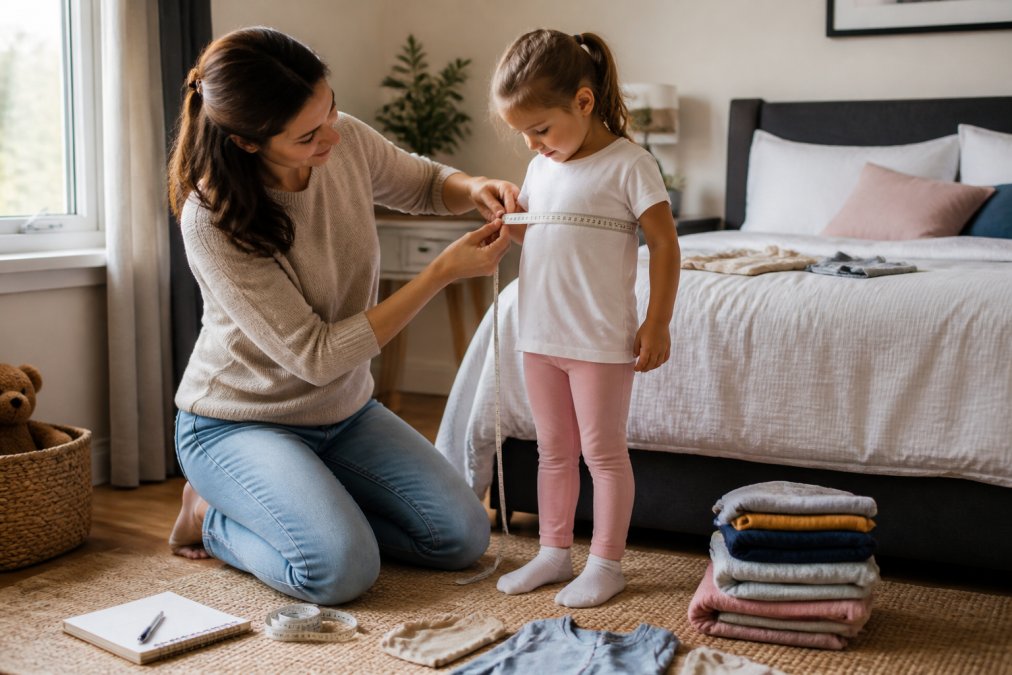
Work through these steps in order:
- Height: Stand the child against a wall, heels together, and mark the top of the head. Measure floor to mark.
- Chest circumference: Run the tape around the fullest part of the chest, under the arms, keeping it level.
- Waist: Measure at the natural waist, above the hip bone, not over a nappy or thick waistband.
- Hip: Measure around the fullest part of the bottom.
- Inseam: Measure from the crotch seam down the inside leg to the ankle bone.
- Write it down with the date. Re-measure every three months, or sooner during a growth spurt.
Reading a Children's Clothing Size Chart by Age and Height
A children's clothing size chart by age and height should be read as two separate signals: height tells you the garment length you need, while age is only a rough starting point. When the two disagree, trust the height and the garment measurements every time.
| Sizing System | What It Measures | Best Used For | Watch Out For |
|---|---|---|---|
| Age-based | Average child at that age | Quick first filter | Ignores height and build entirely |
| Height-based | Standing height in cm | Tops, dresses, outerwear | Cut can still be slim or generous |
| Weight-based | Reference weight in kg | Babywear and sleepwear | Weight and height rarely match together |
Vanity Sizing, Fast Fashion and the Quality Control Problem
Vanity sizing has crept into childrenswear, and it does real damage. A brand that labels a larger garment as a smaller size flatters the parent's sense of their child's growth, but it breaks fit consistency across a wardrobe and makes hand-me-downs unreliable. When a "2 years" dress fits a three-year-old, that label has stopped meaning anything.
What Vanity Sizing Looks Like in Practice
In adult fashion, vanity sizing is well documented: a size that once measured 66 cm at the waist now measures 71 cm, so the shopper feels slimmer in the same number. In childrenswear the same logic plays out differently. A brand may quietly widen its base block so that a child who has outgrown a competitor's 3-4 still fits its own 3-4.
Baby Pants With Cartoon Patches →
Why Fast Fashion Breaks Batch Consistency
Fast fashion sharpens the problem, and the mechanism is worth understanding. A single range may be split across several factories to hit a delivery date, and each factory cuts from its own copy of the pattern. Small differences in how the fabric is laid, how much it is allowed to relax before cutting, and how the seam allowance is trimmed all accumulate.
How to Spot a Brand That Controls Its Sizing
You do not need inside information to judge this. A few signals separate the careful from the careless:
- Published garment measurements for every size, not just an age label.
- A stated tolerance, such as a chest measurement accurate to within a centimetre or two.
- Stable sizing across seasons, so a repeat purchase fits like the last one.
- Consistent sizing across a range, so a top and a trouser in the same size actually match.
Tips for Buying Clothes for Fast-Growing Kids
Buying for a fast-growing child is a planning problem, not a shopping problem. The goal is a small wardrobe that fits now and still fits in three months.
- Buy to the larger measurement when a child is between sizes, but only for tops and outerwear. For trousers, a too-long leg is a trip hazard.
- Prioritise adjustable waists and elasticated waistbands, which absorb a growth spurt without a size change.
- Choose height-based sizing for outerwear so a coat covers the wrists through winter.
- Buy fewer, better pieces. A well-made jogger survives two children; a cheap one usually survives one season.
- Keep a written measurement card in your phone and check it before every order.
Fabric, Shrinkage and How Garments Hold Their Shape
Shrinkage rate is the quiet variable in every size chart. Cotton garments can shrink after the first few washes, and a top that fits on day one can sit a centimetre shorter by week three. This is why a garment's stated measurements should always be treated as pre-wash figures.
Fabric composition drives how much a garment moves:
- Pure cotton breathes well and softens with washing, but can shrink unless pre-shrunk.
- Cotton blends hold their shape better and shrink less.
- Polyester resists shrinking and wrinkling, and keeps its printed shape through repeated washing.
Conclusion
Sizing variance is not a flaw you can shop your way around; it is a structural feature of an industry with no single enforced standard. The fix is measurement: know your child's height, chest, waist, and inseam, and buy from brands that publish garment measurements rather than hiding behind an age label.
Frequently Asked Questions
Why are clothing sizes so inconsistent across different brands?
Each brand drafts its own patterns from its own block, so a size 4 in one shop is a size 5 in another. Manufacturing tolerances of 2-3cm are standard in the textile industry, and shrinkage after washing adds further variance.
Do kids' sizes actually correlate with their chronological age?
Loosely, at best. Age-based labeling assumes average growth, but children of the same age can differ by 10cm or more in height. Growth percentiles show wide natural variation. A size chart by age and height is a starting point, not a guarantee. Always check the garment measurements and your child's actual height before buying.
How can I accurately measure my child for clothing?
Use a soft tape measure over light clothing. Record height from head to floor, chest circumference at the fullest point, waist at the natural crease, and inseam from crotch to ankle. Write the numbers down and keep them on your phone. Compare those figures against each brand's size chart rather than relying on the age label.
Should I always size up when buying children's clothes?
Not always. Sizing up works for outerwear and sleepwear where a little room helps, but it backfires on trousers that slip down or tops that swallow small frames. For fast-growing kids, buy true to current measurements in everyday basics and size up only in coats and layers.
Stop guessing at size labels and start buying clothes that actually fit. Get started with Chez-Suzieaby and build a wardrobe your children can grow into, season after season.