

Frugi Alternative for Organic Baby Clothes: 2026 Guide

Table of Contents
- Why Parents Look for a Frugi Alternative for Organic Baby Clothes
- What GOTS Certified Baby Clothes UK Parents Should Look For
- How to Build a Sustainable Baby Wardrobe Without Overspending
- Affordable Sustainable Baby Brands: What to Expect at Each Price Point
- Durability and Wash Performance: Which Organic Baby Clothes Last
- Resale Value and the Second-Hand Market for Organic Baby Clothes
- Seasonal Picks: Organic Cotton Essentials for Every Weather
- Frequently Asked Questions
Last Updated: September 25, 2026
Why Parents Look for a Frugi Alternative for Organic Baby Clothes
Parents search for a Frugi alternative for organic baby clothes because the brand they loved has become harder to justify at the till. Frugi built its reputation on bright prints and certified cotton, and it earned that loyalty honestly. The problem is price. A single sleepsuit can cost more than a week of nappies, and children grow out of it in weeks.
What GOTS Certified Baby Clothes UK Parents Should Look For
GOTS certified baby clothes carry the Global Organic Textile Standard, the leading certification for organic fibre content and processing. A GOTS label confirms the garment contains at least 70% certified organic fibres, with stricter rules on dyes, wastewater, and factory conditions. The standard also sets social criteria for the factories that cut and sew the garment, which is why it is treated as a chain-of-custody mark rather than a simple fibre claim.
For parents, the practical checks are simple:
- Certification body and licence number printed on the label, not just a leaf logo
- Fibre percentage stated clearly, ideally 95% or higher organic cotton
- Dye and finish claims that specify azo-free or low-impact dyes
- Safety classification for infant skin contact, such as Class A
Fabric Composition: What's Actually in the Label
Fibre composition is where premium pricing often falls apart under scrutiny. A garment described as "cotton rich" may contain as little as 60% cotton, with the remainder polyester, viscose, or elastane. That blend matters more than the marketing.

| Fibre | Breathability | Moisture handling | Durability | Skin sensitivity | Best for |
|---|---|---|---|---|---|
| Organic cotton | High | Absorbs well, dries slowly | Good, improves with washing | Very low irritation risk | Everyday base layers, sleepsuits |
| Bamboo (viscose or lyocell) | Very high | Wicks quickly, feels cool | Weaker when wet, pills over time | Low, but processing chemicals vary | Summer rompers, swaddle layers |
| Hemp | Moderate | Absorbs more than cotton | Excellent, softens with age | Low, but coarser initially | Outerwear, trousers, hand-me-downs |
| Cotton/elastane blend | Moderate | Absorbs well | Good shape recovery | Low, unless sensitive to elastane | Fitted pieces that need stretch |
A few practical rules follow from that table:
- For the first three months, organic cotton is the safest default. It is the least likely to trigger irritation and the easiest to wash at high frequency.
- For summer, bamboo blends feel cooler against skin, but check whether the bamboo is lyocell (closed-loop processing) or viscose (heavier chemical use). The label rarely says which, so ask the brand.
- For outerwear and trousers, hemp blends outlast cotton by a wide margin, though they feel stiffer for the first few washes.
- Treat elastane as a functional additive, not a filler. A 95% cotton / 5% elastane blend is fine for fitted pieces; a 60% cotton / 40% polyester blend is a cost decision, not a comfort one.
How to Build a Sustainable Baby Wardrobe Without Overspending
A sustainable baby wardrobe works on a simple principle: fewer pieces, higher quality, better rotation. Buy 10 to 12 core items that mix and match, and you will spend less than you would on 25 cheap pieces that pill, shrink, and get discarded.
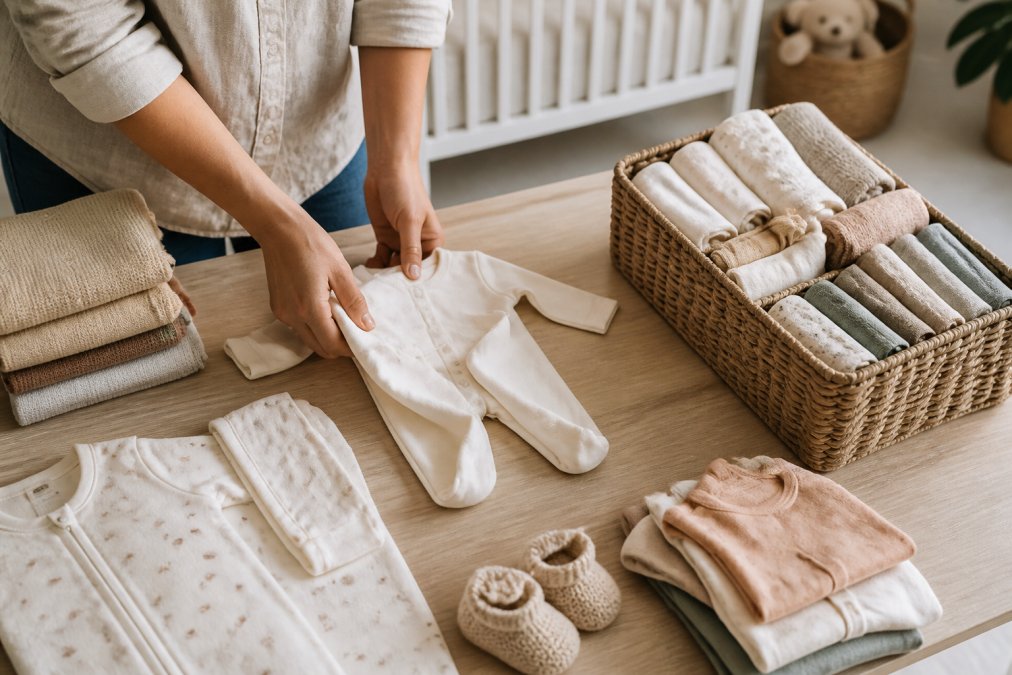
The practical steps:
- Count what you actually need. Newborns need roughly 8 to 10 bodysuits, 6 sleepsuits, and 4 layering pieces per size.
- Buy neutral base layers. Plain colours and unisex cuts pass between siblings and resell better.
- Size up on outerwear. A slightly roomy coat or jacket lasts two seasons instead of one.
- Wash cold and line dry. Heat is what kills cotton, not wear.
- Rotate, don't stockpile. Keep a small active drawer and store the rest.
The Capsule Approach: Fewer Pieces, Better Quality
A capsule wardrobe for a baby usually runs to 12 to 15 items covering a full season. The aim is that every piece works with every other piece, so you stop buying one-off outfits that get worn twice.
Affordable Sustainable Baby Brands: What to Expect at Each Price Point
Affordable sustainable baby brands cluster into three rough tiers, and the differences between them are mostly about certification depth and construction, not fabric feel. Cotton is cotton. What changes is how it was grown, dyed, and stitched.
| Price Tier | Typical Cost Per Item | What You Get | Watch For |
|---|---|---|---|
| Entry | £10-£18 | Basic cotton, limited certification | Thin fabric, loose seams |
| Mid | £18-£30 | Certified cotton, reinforced stitching | Vague fibre claims |
| Premium | £30+ | Full GOTS chain, heavier fabric | Paying for the label |
Durability and Wash Performance: Which Organic Baby Clothes Last
Durability comes down to three things: stitch density, seam finishing, and how the fabric was pre-shrunk. A garment with 12 to 14 stitches per 3cm will outlast one with 8 stitches every time, regardless of what the label claims about softness.
Sizing Consistency Guide: Getting the Fit Right First Time
Sizing is the single biggest source of returns in baby clothing, and the cause is usually a mismatch between Asian and European size standards. Many imported garments run one to two sizes smaller than the label suggests.
Gender Neutral Baby Onesies | Organic →
Before you buy:
- Measure your child's height, not their age. Height is the reliable variable.
- Compare against the brand's own chart, not a generic one.
- Size up if between sizes. A slightly loose sleepsuit is safe; a tight one is not.
- Allow 2-3cm tolerance on any manually measured garment.
Resale Value and the Second-Hand Market for Organic Baby Clothes
Certified organic cotton holds resale value better than fast-fashion equivalents, because buyers on the second-hand market are specifically searching for it. A well-kept GOTS-certified sleepsuit can resell for 30% to 50% of its original price, while a supermarket equivalent often sells for pennies or not at all.
- Brand recognition. Buyers search by name, so a garment from a brand they already know sells faster than an identical garment from an unknown label.
- Certification visibility. A GOTS licence number on the label is a trust signal in a resale listing. Without it, buyers assume the "organic" claim is marketing.
- Condition after washing. Pilling, fading, and stretched necklines are the three defects that kill resale price. A garment washed cold and line-dried will look noticeably better at resale than one tumble-dried.
- Completeness. A matching set, or a garment with its original tags, sells for more than a loose single item.
Where Organic Baby Clothes Actually Resell
The second-hand market for baby clothing in the UK runs across three broad channels, and each rewards a different kind of seller:
- General marketplaces (eBay, Vinted, Depop) reach the widest audience but compete on price. Bundles of five to ten items in the same size sell far better than single listings, because buyers are usually restocking a whole drawer.
- Specialist resale and parent communities (local parent groups, school-run sales, NCT-style nearly-new sales) reward brand knowledge. A buyer at a nearly-new sale already knows what GOTS means, so certification carries more weight there than on a general marketplace.
- Charity shops and clothing banks are the fallback, not the plan. They take anything, but they pay nothing, so they only make sense for items that have already failed to sell elsewhere.
The True Cost Calculation
This is the strongest argument for buying mid-tier rather than entry-tier. If a £25 sleepsuit resells for £10, your net cost is £15. A £12 sleepsuit that resells for £2 costs you £10, but you replace it twice as often, and the second purchase has no resale value left in it at all.
Seasonal Picks: Organic Cotton Essentials for Every Weather
Seasonal dressing for babies is about layering, not about buying a new wardrobe four times a year. Cotton regulates temperature well on its own, so the same base layers work in July and January with different outer pieces.
Frequently Asked Questions
Are there more affordable alternatives to Frugi for organic baby wear?
Yes. Several brands now offer organic cotton baby clothes at lower price points than Frugi. Look for pieces made from at least 90% organic cotton with visible certifications such as GOTS. Chez-Suzieaby, for example, offers organic cotton baby onesies from £25.90 and breathable two-piece outfits from £17.56, giving parents certified-quality fabric without the premium markup.
How can I identify truly sustainable baby clothing brands?
Check three things: the certification label (GOTS is the gold standard for organic cotton), the fabric composition breakdown on the product page, and whether the brand publishes care and longevity information. A brand that lists exact cotton percentages and safety classifications is more transparent than one using vague terms like 'eco-friendly'. Certifications you can verify beat marketing claims every time.
What makes organic cotton better for newborn skin?
Organic cotton is grown without synthetic pesticides, and GOTS-certified processing bans harmful dyes and finishes. For newborns, whose skin is thinner and more absorbent than adults', this reduces exposure to chemical residues. Organic cotton is also naturally breathable and hypoallergenic, which helps with thermal regulation and lowers the risk of irritation. Look for Class A safety ratings on infant garments for added assurance.
Where can I buy GOTS certified baby clothes online?
GOTS-certified baby clothes are available from specialist online retailers, including Chez-Suzieaby, which stocks organic cotton rompers, bodysuits, and sets. When shopping online, filter by certification rather than by brand name. Check that the product page states the cotton percentage and any safety classification, such as Class A. If a listing does not mention certification, contact the seller before buying.
How do I know the sizing will actually fit my child?
Always measure your child's height and chest rather than relying on age labels, which vary between brands. Compare those measurements against the specific sizing information provided. Many brands use sizing standards that can differ, so sizing up is often wise. If measurements fall between two sizes, choose the larger option for room to grow.