

How to Spot High Quality Stitching in Infant Clothing

Last Updated: November 5, 2026
Quick Summary
Good quality infant clothing stitching shows as consistent, tight, even stitches with no loose threads, smooth flat seams against the skin, and clear safety labelling. You can check all three in under a minute by turning the garment inside out and inspecting every seam. Flat seams and French seams are the kindest against a baby's skin.
- Turn the garment inside out and check for even, closely spaced stitches with no gaps.
- Any loose thread longer than about 1 cm should be treated as a fault, not trimmed.
- Flat seams and French seams are the kindest against a baby's skin.
- Check shoulder seams, crotch seams, armholes, cuffs and popper points for reinforcement.
- Wash inside out on a gentle, low-spin cycle and skip fabric softener to protect seams.
Table of Contents
- Why Stitching Matters More Than You Think
- How to Tell If Baby Clothes Are Good Quality
- Baby Clothes Seam Quality: What to Look For
- Why Flat Seams in Baby Clothes Protect Delicate Skin
- How to Wash Baby Clothes So Stitching Lasts
- At-Home Durability Tests and Care Checks
- Choosing Infant Clothing You Can Trust
- Frequently Asked Questions
Why Stitching Matters More Than You Think
Infant clothing stitching is the quiet structure holding a garment together. A garment can feel soft in the shop and still fail at the seams, and that failure matters more on a baby than on anyone else.
The seams tell you more about a garment than the price tag does. The signs of high quality stitching in infant apparel rarely show on the outside. You have to look for them.
Here is what most guides get wrong: they judge baby clothes by fabric alone.
How to Tell If Baby Clothes Are Good Quality
Good quality baby clothes show consistent, tight, even infant clothing stitching with no loose threads, smooth flat seams against the skin, and clear safety labelling. You can check all three in under a minute by turning the garment inside out.
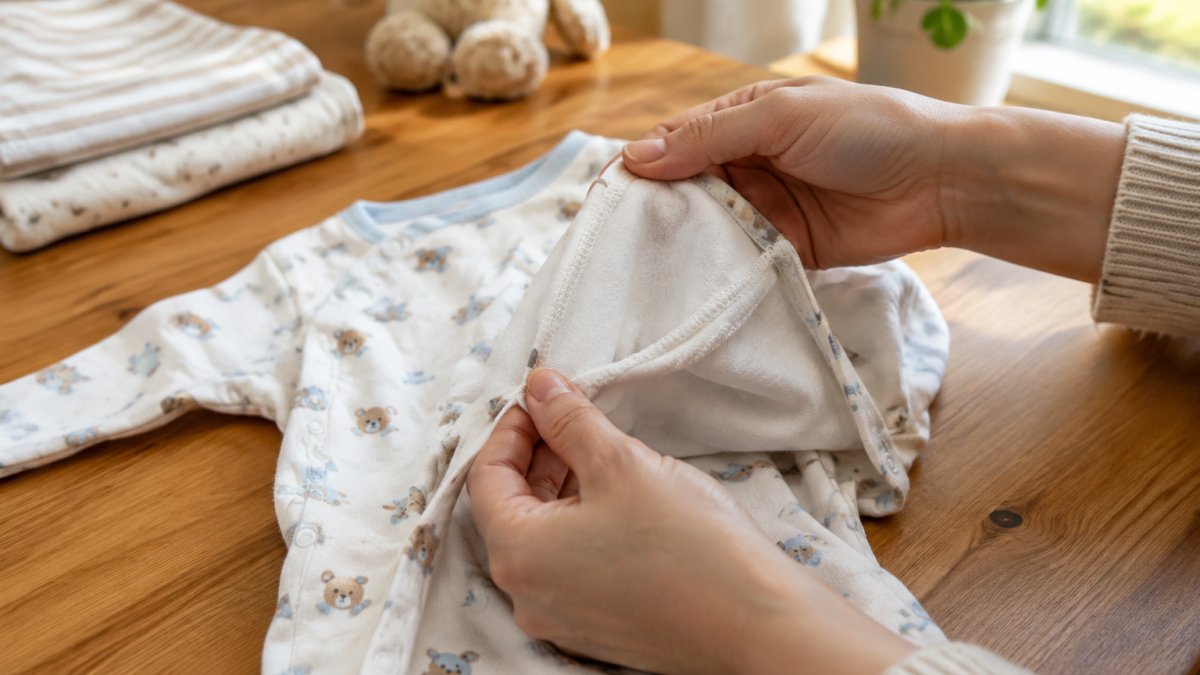
The fastest quality check is the one most shoppers never do: flip the garment. The inside of a baby garment is where the truth lives.
Turn the Garment Inside Out
Run your eyes and fingertips along every seam. Look for these signs:
- Even, closely spaced stitches with no gaps
- No loose or trailing threads
- Seams that lie flat, not puckered or wavy
- No rough, stiff seam edges against the skin
A common mistake is only checking the outside. The outer face of a garment can look flawless while the inner seams scratch.
Check the Labels and Safety Class
Labels carry real information. Look for fibre content, wash instructions and a safety classification. Clear labelling is a useful sign of a maker who expects scrutiny. For guidance on what childrenswear must comply with, see the Office for Product Safety and Standards guidance.
If a label is missing, vague or peeling, treat that as a warning sign. Clear labelling signals a maker who expects scrutiny.
Baby Clothes Seam Quality: What to Look For
Baby clothes seam quality comes down to three things: how dense the stitching is, what thread is used, and which seam type sits against the skin. Dense stitching with strong thread and flat seams will outlast sparse stitching with bulky seams every time.
Stitch Density and Thread Strength
Stitch density means how many stitches sit in a given length of seam. Denser stitching holds better and flexes with movement. Sparse stitching leaves gaps that widen with each wash.
Even, closely spaced stitching matters more than any single number.
Thread choice matters too. Most durable infant seams use a fine, smooth polyester or polyester-cotton core thread rather than a soft, fuzzy cotton thread, because core thread resists abrasion and repeated washing.
What Poor Stitching Actually Looks Like
Knowing the failure modes makes the inspection faster. Look for these specific faults:
- Skipped stitches: gaps where the needle missed the fabric, leaving a short unsewn run. Hold the seam to the light; skipped stitches show as bright pinholes.
- Loose or trailing threads: long loops on the inside face that can wrap around a toe or finger. Any thread longer than about 1 cm should be treated as a fault, not a trimming job for you to do.
- Puckering: fabric that ripples along the seam line because the thread tension was wrong or the fabric was stretched during sewing. Puckering does not flatten out with washing and often worsens.
- Weak seam finishes: raw edges that are not enclosed at all, or overlocking that stops short of the seam end, leaving a fraying tail.
Seam Types and How They Age
Not all seams are equal. Here is how the main types behave:
| Seam Type | Feel Against Skin | How It Ages | Best For |
|---|---|---|---|
| Flat seam | Smooth, no ridge | Holds shape well | Next-to-skin baby wear |
| Overlock | Can feel raised | May fray if thread is thin | Stretchy knits |
| French seam | Very smooth | Durable, hides raw edges | Lightweight cotton |
| Plain seam | Ridge against skin | Can pucker | Non-contact areas |
Flat seams and French seams are the kindest against a baby's skin. Overlocked seams work well on stretchy fabrics but need quality thread to last. A French seam encloses the raw edges inside a second row of stitching, so there is nothing to fray; a flat seam joins two edges with a cover stitch that lies level with the fabric.
Stress Points and Reinforcement
Seams fail first where movement concentrates. Check the shoulder seams, the crotch seam on bodysuits, the armhole and cuff joins, and the points where poppers or buttons are attached. Good construction adds a second row of stitching, a bar tack or a small patch of reinforcement at these points. A single line of stitching running straight through a crotch seam with no reinforcement is a sign the maker expected the garment to be outgrown before it wore out.
Why Flat Seams in Baby Clothes Protect Delicate Skin
Flat seams in baby clothes protect delicate skin by removing the raised ridge that rubs during movement and lying down.
Comfortable Cotton Infant Jumpsuit | Breathable Cotton Baby Outfit →
Newborn skin is thin and easily irritated. A bulky seam along the back or inner leg creates constant friction, especially during tummy time and sleep.
For parents choosing garments for reactive skin, our guide on how to choose baby clothes for sensitive skin walks through fabric and seam choices in more detail.
How to Wash Baby Clothes So Stitching Lasts
Washing is where good stitching proves itself. Turn garments inside out, use a gentle cycle, and skip harsh detergents to keep seams and thread intact for longer.
Follow these steps:
- Turn every garment inside out before washing
- Fasten poppers and buttons to stop them snagging seams
- Use a gentle, low-spin cycle
- Wash at a lower temperature to protect thread and elastic
- Skip fabric softener, which can weaken fibres
- Air dry where possible, or use a low tumble setting
If you want a fuller routine, our guide on how to wash kids clothes properly covers temperatures and sorting. When a care label uses symbols you do not recognise, check laundry care symbols explained before you wash.
Watch out: washing on a hot, high-spin cycle is the quickest way to loosen stitching and shrink cotton, and the damage usually shows up at the seams first.
At-Home Durability Tests and Care Checks
You can test durability at home without any special tools. A gentle stretch, a light tug on the seams, and a check after each wash will tell you whether a garment is holding up. The point of these checks is not to prove a garment is safe in every respect, only a proper assessment can do that, but to catch the construction faults most likely to cause irritation or a loose-thread hazard before your baby wears the item.
Try these checks:
- The stretch test: gently stretch the fabric across a seam. It should spring back without the stitches opening. If you can see daylight through the stitch line, the seam is too loose for repeated washing.
- The tug test: pull a seam sideways with light pressure. Firm resistance means strong stitching. A seam that yields easily or shows a gap between the two fabric edges will fail at a stress point.
- The rub test: run a finger along inner seams. Any roughness will rub a baby's skin the same way. Pay particular attention to the neckline, inner legs and the seam running down the back.
- The thread check: run a fingertip along every seam and trim nothing yourself. Loose loops longer than about 1 cm should be treated as a fault, return the garment rather than cutting the thread, because cutting can unravel the seam.
- The wash check: inspect seams after every few washes for fraying, thinning thread or puckering. Damage usually appears at the crotch, cuffs and neckline first.
Stitching Faults That Matter for Infant Safety
Poor stitching is not only a durability problem. Loose threads can wrap around a finger or toe, detached trims and buttons are a choking risk, and rough seam edges cause friction against thin skin.
Watch out: a garment that passes a gentle tug test at home can still have a hidden fault, so treat these checks as a first filter rather than a guarantee.
Care Checks That Keep Stitching Intact
How you wash and dry a garment affects how long its seams last. Turn items inside out, fasten poppers and buttons, use a gentle low-spin cycle, wash at a lower temperature, skip fabric softener, and air dry where possible.
For parents planning ahead as little ones grow, our recommendations for durable clothes for fast growing toddlers focus on garments built to survive growth spurts and hand-me-downs.
Choosing Infant Clothing You Can Trust
Trustworthy infant clothing combines clear labelling, dense stitching, flat seams and fabric that stays soft after washing. You can confirm all of these in the shop or at home in a couple of minutes.
A few habits make the difference:
- Always turn the garment inside out before buying
- Check the label for fibre content and safety class
- Feel the seams against the inside of your wrist
- Look for reinforced stress points
- Buy from makers who label clearly and consistently
The Comfortable Cotton Infant Jumpsuit is a soft, breathable everyday option, and our rompers are made from premium cotton for everyday wear. If you want a well-stitched cotton staple for your baby's wardrobe, start there.

Frequently Asked Questions
How can you tell if baby clothes are well made?
Turn the garment inside out and look at the seams first. Well-made infant clothing has straight, even stitching with no loose threads, no skipped stitches and no puckering along the seam line. Check that the labels state a safety class and that fastenings like poppers and zips sit flat. Gently tug a seam between your fingers: if it gapes or the thread looks thin and fuzzy, the construction is weak and will likely fail after a few washes.
What should I look for in the seams of baby clothes?
Look for baby clothes seam quality in three areas: density, finish and placement. Stitching should be tight and consistent, with no gaps. The seam should be finished so raw edges do not fray, either overlocked or enclosed. Finally, seams should sit away from pressure points and never rub directly against the skin. Run your finger along the inside seam; if you feel a hard ridge, it will irritate a baby's skin.
Are flat seams better for babies?
Yes, flat seams in baby clothes are generally better for delicate skin. A flat seam joins fabric without a raised bulky ridge, so it lies smooth against the body and reduces friction during movement, naps and nappy changes. This matters most at the shoulders, underarms and crotch, where fabric presses against skin for hours. Flat seams also tend to hold their shape through washing, so the garment stays comfortable for longer and is less likely to develop rough edges that scratch.
How should I wash baby clothes to keep the stitching strong?
Wash baby clothes inside out on a gentle cycle at 30°C or lower, and fasten poppers and zips before washing so they do not catch on other garments. Use a mild, non-biological detergent and skip fabric softener, which can coat threads and weaken them over time. Avoid overloading the machine, as friction between garments pulls at seams. Air dry where possible; if you tumble dry, use a low heat setting, because high heat shrinks thread and can cause seams to pucker.
The real test of infant clothing is not how it looks on the hanger, but how it holds up after the tenth wash and the hundredth nap. Check the seams, read the labels, and choose garments made to last. Explore the Chez-Suzieaby cotton range and dress your little one in comfort you can trust.
